The individual investigation is the Internal Assessment (IA) component of the ESS course. It should be a topic of personal interest to the student. My role as teacher is not to tell a student what s/he should investigate, but rather to guide her or him through the investigative process.
Approximately 10 teaching hours are dedicated to the individual investigation.
According to the IB ESS Guide (2017): The internal assessment investigation consists of: identifying an ESS issue; developing methodologies to generate and analyse data; and applying the outcomes to understand or address the broader ESS context.
The Internal Assessment is scored against the following criteria:
- Identifying the context (6 marks, 20%)
- Planning (6 marks, 20%)
- Results, analysis, and conclusion (6 marks, 20%)
- Discussion and evaluation (6 marks, 20%)
- Applications (3 marks, 10%)
- Communication (3 marks, 10%)
With the exception of “communication”, I would recommend students use the criteria as broad organizational tools for their writing. The list below summarizes what the IB is looking for in the ESS IA, and it serves as a general outline for organizing the IA. For guidance, I’ve included the rubrics I use with my own classes.
Identifying the context:
- state a relevant, coherent and focused research question
- discuss a relevant environmental issue (either local or global) that provides the context for the research question
- explain the connections between the environmental issue (either local or global) and the research question.

Planning
- design a repeatable method appropriate to the research question that allows for the collection of sufficient relevant data
- justify the choice of sampling strategy used
- describe the risk assessment and ethical considerations where applicable.

Results, analysis and conclusion
- construct diagrams, charts or graphs of all relevant quantitative and/or qualitative data appropriately
- analyse the data correctly and completely so that all relevant patterns are displayed
- interpret trends, patterns or relationships in the data, so that a valid conclusion to the research question is deduced.

Discussion and evaluation
- evaluate the conclusion in the context of the environmental issue
- discuss strengths, weaknesses and limitations within the method used
- suggest modifications addressing one or more significant weaknesses with large effect and further areas of research.

Applications
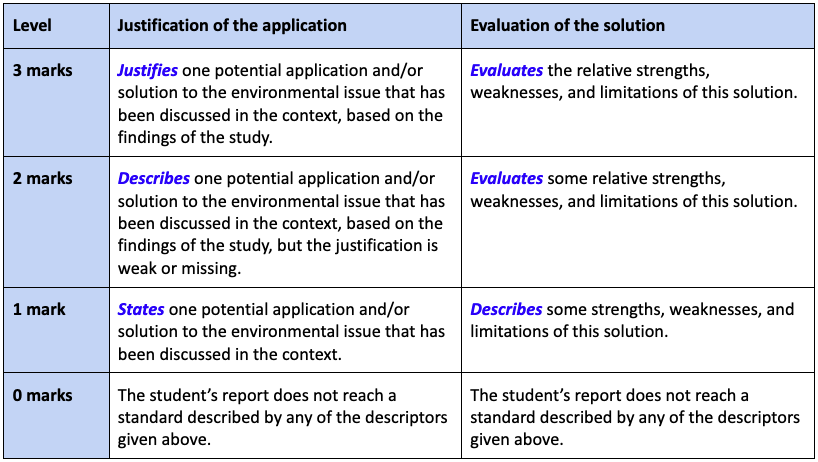
- justify one potential application and/or solution to the environmental issue that has been discussed in the context, based on the findings of the study
- evaluate the solution‘s strengths, weaknesses and limitations (Do NOT evaluate the method here! That should be done in the discussion and evaluation section above.)
Communication
Students don’t have to write anything for the communication points. This rubric addresses how they organise and communicate their ideas within the IA.

I created a free template for the ESS Internal Assessment report. The template is formatted for APA style. All you have to do is replace my instructions with your own work – it’s that easy!
Click this link to make your own editable copy of the report. You must use a Gmail account to make a copy.
 MrKremerScience.com
You must be logged in to post a comment.