
Well, today was a little wacky, with no electricity or projector, class photographs in the middle of one class, and virtually no air circulating in my room to make for a hot hot hot day at school. Add in the noise and distraction of holding class in the courtyard, and we have….well, we have a bit of a mess.
Just so we’re all on the same page of the biology unit, I thought I’d summarize the key points from today’s lesson on biological molecules. Below are the finer points of the lesson.
The 3 major functions of all biological molecules
- Instructions
- Energy storage
- Source of energy
 Carbohydrates

- chains of C, H, and O
- supply all energy in cells and food chains
- energy tends to be short-term energy (glycogen)
- simple sugars such as glucose may build more complex molecules
- some long chains of sugars, such as cellulose, are used for cellular structure
 Lipids

- do not dissolve in water
- long chains of C, H, O, and P
- have more bonds than carbs, so they’re used for energy storage
- slow release of energy
- saturated fats: all single C-H bonds, tend to be solids
- unsaturated fats: some C-C double bonds, tend to be liquids (oils)
-

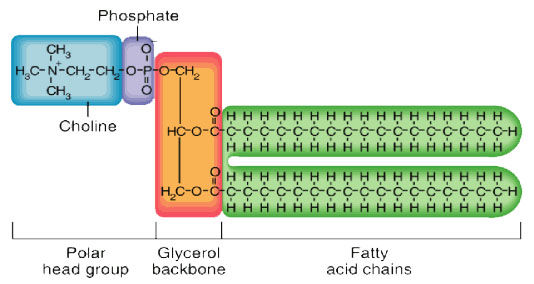
Image credit: http://www.uic.edu phospholipids make up cell membranes and have two main parts:
- a phosphate group at one end, which is polar (charged), meaning it is hydrophilic
- the hydrophobic hydrocarbon tails
Proteins
- most important biological molecule
- many functions in organisms:
- enzymes
- structural components (building blocks)
- hormones
- antibodies
- made of chains of amino acids
- only 20 amino acids make all the 1000’s of proteins in the world
Nucleotides
- made of C, H, O, P, and N
- 3 parts of each nucleotide:
- nitrogen base
- sugar
- phosphate
-

4 different nitrogen bases to know: A-C-G-T (shown at right)
- several functions in organisms:
- chemical messengers
- coenzymes
- carry energy from one part of a cell to another
- build nucleic acids
- two kinds of nucleic acids:

- DNA: sequence of nucleotides makes up the genetic code of an organism
- RNA: translates the code into specific proteins


And finally, the slides from class…
You must be logged in to post a comment.