


Description
IB ESS Practical 2.2B: Food Chains from Data 
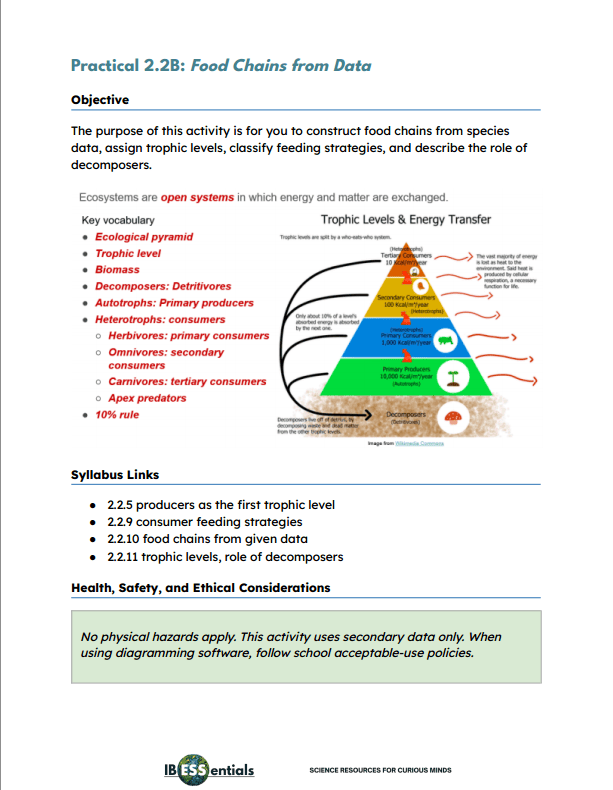
Teach trophic levels and feeding strategies clearly and accurately by having students build food chains from real species data.
In this practical activity, students work from a data table of feeding relationships in a coastal grassland. The species include marram grass, sea holly, grasshoppers, rabbits, wolf spiders, kestrels, earthworms, and soil fungi, all identified by both common and scientific names. Students:
- Classify feeding strategies: identify the producers and assign each consumer a feeding strategy: herbivore, detritivore, predator, parasite, saprotroph, scavenger, or decomposer
- Construct food chains: build the longest possible food chain from the data and a second, shorter chain, with arrows drawn in the direction of energy flow
- Assign trophic levels: state the trophic level of every organism in each chain
- Consider decomposers: explain why decomposers are usually left out of food chains and describe their role in energy transformation
- Look for complications: identify an organism that could occupy more than one trophic level and explain when it would do so
Write-in space is provided for both food chains.
The activity teaches trophic levels on their own before omnivory and food webs complicate the picture in Practical 2.2C.
IB ESS Internal Assessment Skills
This activity is assessed using IB ESS Internal Assessment Criterion C: Method, and the full rubric is included. Students must:
- Describe how they assigned trophic levels and constructed their chains clearly enough for another student to produce the same chains
- Explain why food chain arrows show the direction of energy flow rather than the act of feeding
- Evaluate whether the data are sufficient to fully describe the ecosystem’s feeding relationships, and identify what information is missing
The activity helps students see that reasoning is part of a method, even when the task seems obvious. The teacher’s notes flag arrow direction as the most common error in this topic. They also explain how the missing information is quantitative, which leads directly into the energy efficiency and pyramid activities that follow.
Ideal for
- Teaching food chains
- Teaching trophic levels
- Classifying consumer feeding strategies
- Teaching the role of decomposers
- Correcting food chain arrow misconceptions
- Introducing energy flow through ecosystems
- Preparing students for the IB ESS Internal Assessment
Digital download. No physical product will be shipped.


You must be logged in to post a comment.