


Description
IB ESS Topic 2 Ecology Practical Activities – Complete Collection 
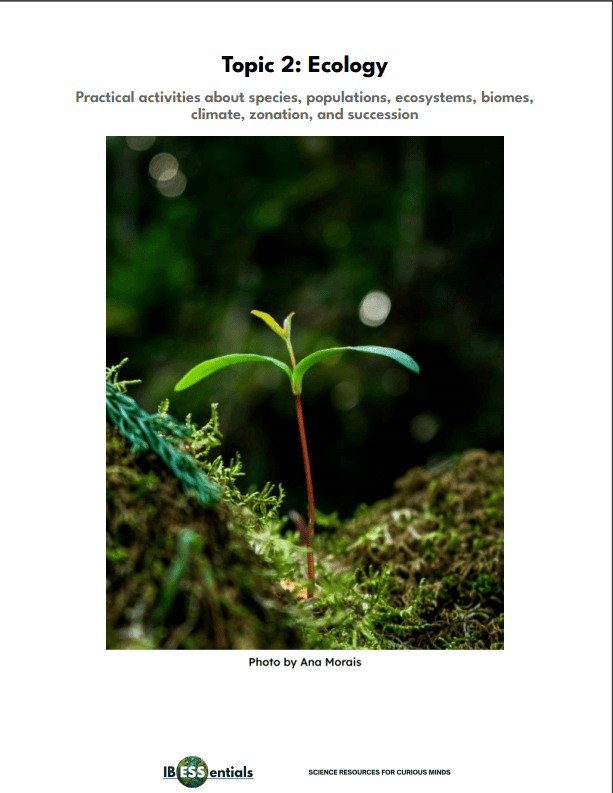
Give your IB Environmental Systems and Societies students hands-on, skills-focused experience of Topic 2: Ecology with this complete collection of classroom-ready practical activities.
Designed specifically for the IB ESS course with first examinations in 2026, this collection provides a structured sequence of fieldwork investigations, laboratory procedures, simulations, and data-analysis tasks covering species, populations, communities, ecosystems, biogeochemical cycles, biomes, zonation, and succession.
Rather than treating ecology as a list of definitions, these activities ask students to identify organisms, sample real ecosystems, measure abiotic factors, model populations and energy flow, construct systems diagrams from data, and evaluate the methods ecologists use.
What’s Included
This collection contains 24 practical activities, including 5 HL-only activities. The HL primary productivity practical is provided in two versions, one for standard dissolved oxygen kits and one for Vernier data-logging equipment.
2.1 Individuals, Populations, Communities, and Ecosystems
Practical 2.1A — Construct a Dichotomous Key
Students build a dichotomous key for at least eight local species using measurable characteristics. They test their key on a classmate’s specimens, revise it based on where it failed, and confirm identifications using apps and databases with correct binomial nomenclature.
Key skills: species identification, classification, binomial nomenclature, peer testing, repeatable methods.
Practical 2.1B — Measuring Abiotic Factors
Students measure at least three abiotic factors across five microhabitats in a local ecosystem using calibrated probes and data logging. They then use scatter plots and correlation coefficients to investigate relationships between the factors.
Key skills: data logging, calibration, fieldwork, repeat measurements, correlation, uncertainty.
Practical 2.1C — Niches and Carrying Capacity
Students use a population simulation to test how abiotic and biotic limiting factors affect population growth. They produce exponential and limited growth curves, identify carrying capacity, and explain density-dependent regulation.
Key skills: simulations, population growth curves, carrying capacity, limiting factors, negative feedback.
Practical 2.1D — Modeling Population Interactions
In three linked parts, students use simulations to investigate competition, the effects of adding consumers to a community, and Lotka–Volterra predator–prey oscillations. They quantify how changing one parameter at a time affects oscillation amplitude and period.
Key skills: population interactions, competitive exclusion, predator–prey models, controlled variables, negative feedback.
Practical 2.1E — Measuring Abundance with Quadrats
Students use random quadrat sampling on a coordinate grid to calculate population density, mean percentage cover, and percentage frequency from the same field data. They then decide which measure best describes different types of organism.
Key skills: random sampling, quadrats, density, percentage cover, percentage frequency, fieldwork.
Practical 2.1F — Measuring Change Along a Transect
Students sample the same line using both an interrupted belt transect and a continuous line transect. They then compare the species detected and the time each method required.
Key skills: transect sampling, systematic sampling, method comparison, graphing change over distance.
Practical 2.1G — The Lincoln Index
Using a classroom capture–mark–release–recapture simulation with paper “organisms”, students estimate population size with the Lincoln index. They compare each estimate with the true population and investigate the method’s assumptions.
Key skills: capture–mark–release–recapture, Lincoln index, percentage error, assumptions, evaluation.
Practical 2.1H — Fundamental and Realized Niches (HL only)
Students use published data, such as Connell’s barnacle experiments, to compare a species’ fundamental and realized niches. They also compare cladograms with traditional taxonomy and predict how human impacts could alter a niche.
Key skills: secondary data, niche analysis, cladistics, source evaluation, evidence-based conclusions.
2.2 Energy and Biomass in Ecosystems
Practical 2.2A — Systems Diagram of an Ecosystem
Students use woodland energy-flow data to construct a scaled systems diagram of photosynthesis and respiration. They classify each flow as a transfer or transformation and verify the first law of thermodynamics at every storage.
Key skills: quantitative systems diagrams, transfers and transformations, energy budgets, first law of thermodynamics.
Practical 2.2B — Food Chains from Data
Students classify coastal grassland species by feeding strategy, construct food chains from the data, assign trophic levels, and explain the role of decomposers.
Key skills: food chains, trophic levels, feeding strategies, decomposers, data interpretation.
Practical 2.2C — Food Webs from Data
Students construct a food web and predict the direct and indirect effects of removing two different species. They use that comparison to decide which species has the stronger claim to be a keystone species.
Key skills: food webs, prediction, keystone species, indirect effects, model limitations.
Practical 2.2D — Energy Transfer Efficiency
Students build a spreadsheet model of energy flow through a prairie ecosystem and calculate the transfer efficiency between trophic levels. They then change the efficiency to test how many trophic levels the ecosystem can support.
Key skills: spreadsheet modeling, transfer efficiency, energy losses, food chain length, data processing.
Practical 2.2E — Ecological Pyramids
Students use three data sets in different units to decide which type of pyramid each supports. They construct scaled pyramids of numbers, biomass, and energy, and explain why pyramids of energy can never be inverted.
Key skills: ecological pyramids, scaling, efficiency calculations, second law of thermodynamics.
Practical 2.2F — Biomass and Energy from Plant Samples
Students dry plant material to constant mass to determine biomass. They then estimate its energy content by combustion and compare their result with published values.
Key skills: laboratory technique, constant mass, calorimetry, experimental error, evaluation.
Practical 2.2G — Measuring Primary Productivity (HL only, two versions)
Students use the light and dark bottle method to calculate gross primary productivity, net primary productivity, and respiration from dissolved oxygen data. Version 1 uses standard DO kits or probes. Version 2 uses Vernier biochambers with continuous gas-sensor data logging.
Key skills: productivity, dissolved oxygen, controlled experiments, replicate design, data processing.
2.3 Biogeochemical Cycles
Practical 2.3A — Systems Diagram of the Carbon Cycle
Students construct a scaled systems diagram of the global carbon cycle from published estimates. They calculate the net annual change in atmospheric carbon and the residence time of carbon in the atmosphere.
Key skills: quantitative systems diagrams, stores, sinks, and sources, residence time, data processing.
Practical 2.3B — Ecosystems as Carbon Stores, Sinks, and Sources
Students analyze carbon flux data from young, mature, and recently burned forests, calculating net primary productivity and net ecosystem productivity for each. They then apply the same reasoning to agricultural soils.
Key skills: carbon sequestration, NPP and NEP calculations, data analysis, evidence-based conclusions.
Practical 2.3C — Systems Diagram of the Nitrogen Cycle (HL only)
Students construct a nitrogen cycle diagram that identifies the role of bacteria and add the flows altered by a named human activity. They then research a management strategy and the tensions it creates.
Key skills: nitrogen cycle, systems diagrams, human impacts, strategies, tensions between perspectives.
2.4 Climate and Biomes
Practical 2.4A — Climate Graphs for Different Biomes
Students construct climate graphs on consistent scales for five locations in different biomes. They identify the main abiotic limiting factor in each and rank the biomes by expected productivity.
Key skills: climate graphs, secondary data, limiting factors, productivity, data communication.
Practical 2.4B — Determine the Biome from Climate Data
Students plot climate data for 14 named locations on the Whittaker biome diagram. They compare predicted and actual biomes, explain the mismatches, and consider how global warming could shift biomes.
Key skills: Whittaker diagrams, unit conversion, prediction, secondary factors, climate change.
Practical 2.4C — The Tricellular Model and Biome Distribution
Students use scatter plots and correlation coefficients to analyze how latitude and distance from the ocean affect temperature and precipitation. They then link the patterns to the tricellular model of atmospheric circulation.
Key skills: correlation, scatter plots, tricellular model, continentality, outlier analysis.
2.5 Zonation, Succession, and Change in Ecosystems
Practical 2.5A — Zonation Along an Environmental Gradient
Students combine transect sampling with repeated measurements of three abiotic factors. They present species distributions as kite diagrams and correlate distribution with abiotic conditions.
Key skills: zonation, transects, kite diagrams, abiotic measurement, correlation, fieldwork.
Practical 2.5B — Mapping Succession
Students use historical satellite imagery and secondary sources to map vegetation change over time at a documented succession site. They identify seral stages and whether a climax community has been reached.
Key skills: mapping databases, secondary data, succession, seral stages, evaluation.
Practical 2.5C — r- and K-Strategists in Different Seres (HL only)
Students sample early and late seral communities, classify plant species by life-history traits, and compare the balance of r- and K-strategists in each sere.
Key skills: random sampling, life-history strategies, classification criteria, succession, bias.
Designed for the 2026 IB ESS Course
The activities are explicitly connected to the IB ESS Topic 2: Ecology syllabus, including SL and HL content, and are designed to develop the practical and analytical skills students need throughout the course.
The collection covers concepts including:
- Species identification, classification, and dichotomous keys
- Abiotic and biotic factors
- Niches, carrying capacity, and population growth
- Population interactions and predator–prey dynamics
- Quadrat, transect, and capture–mark–release–recapture sampling
- Fundamental and realized niches and cladistics (HL)
- Energy flow and the laws of thermodynamics
- Food chains, food webs, and keystone species
- Transfer efficiency and ecological pyramids
- Biomass and energy content of producers
- Gross and net primary productivity (HL)
- The carbon cycle, carbon sequestration, and stores, sinks, and sources
- The nitrogen cycle and human impacts (HL)
- Climate graphs, biomes, and the Whittaker diagram
- The tricellular model and biome distribution
- Zonation along environmental gradients
- Succession, seral stages, and climax communities
- r- and K-strategists (HL)
Strong IB ESS Internal Assessment Connections
These are not simply worksheets containing questions about the syllabus. The activities deliberately develop skills that students will use in their IB ESS Internal Assessment, and Topic 2 is where most students first meet the fieldwork techniques they later use in their own investigations.
Across the collection, students practice:
- Designing repeatable sampling methods
- Choosing appropriate sampling techniques
- Calibrating equipment and using data logging
- Collecting sufficient data through repeats and replicates
- Communicating raw and processed data clearly
- Processing quantitative data accurately
- Identifying patterns, trends, and correlations
- Considering bias, reliability, validity, and uncertainty
- Evaluating methods and models
- Identifying limitations and proposing improvements
- Developing evidence-based conclusions
- Analyzing strategies and the tensions they create
The collection provides activities connected to IB ESS Internal Assessment Criteria B, C, D, E, and F. Each activity includes the relevant IA rubrics, and the teacher’s notes explain how each assessment prompt connects to specific criteria and mark bands.
Teacher’s Notes Included
This is a teacher-supported collection, not simply a set of student activity sheets.
The included teacher’s notes provide:
- Rationale for each practical
- Health, safety, and ethical considerations, including the IB animal experimentation policy
- Guidance on common misconceptions and errors
- Connections to specific IB ESS syllabus points
- Connections to Internal Assessment criteria and mark bands
- Practical preparation tips for fieldwork, laboratory, and simulation lessons
For example, the teacher’s notes explain how the sequence moves students from identifying and sampling organisms into modeling energy flow, cycling matter, and interpreting large-scale patterns in biomes and succession.
Ideal For
This IB ESS practical collection is ideal for:
- IB Environmental Systems and Societies teachers
- Teachers preparing students for the 2026 IB ESS examinations
- International schools and IB World Schools
- Teachers introducing Topic 2: Ecology
- SL and HL ESS classes
- Teachers looking for ready-to-use ESS practical activities
- Ecological fieldwork and sampling lessons
- Teaching energy flow, food webs, and ecological pyramids
- Teaching the carbon and nitrogen cycles
- Teaching biomes, climate graphs, and the tricellular model
- Teaching zonation and succession
- Building IB ESS Internal Assessment skills
- Paper 1 and Paper 2 skills development
- Revision and consolidation of Topic 2 concepts
A Practical Way to Teach Topic 2
The activities can be used individually as lessons or combined into a longer Topic 2 practical sequence.
Together, they give students repeated opportunities to move between:
Field → Data → Model → Analysis → Evaluation
The collection balances outdoor fieldwork, laboratory procedures, computer simulations, and secondary-data analysis. This lets teachers deliver the full topic even when weather, equipment, or site access is limited.
It also deliberately revisits sampling, systems diagrams, correlation, uncertainty, and evaluation in increasingly complex contexts. This helps students build the transferable skills they need for later ESS topics and their Internal Assessment.
Digital download. No physical product will be shipped.


You must be logged in to post a comment.