


Description
IB ESS Practical 2.2F: Biomass and Energy from Plant Samples 
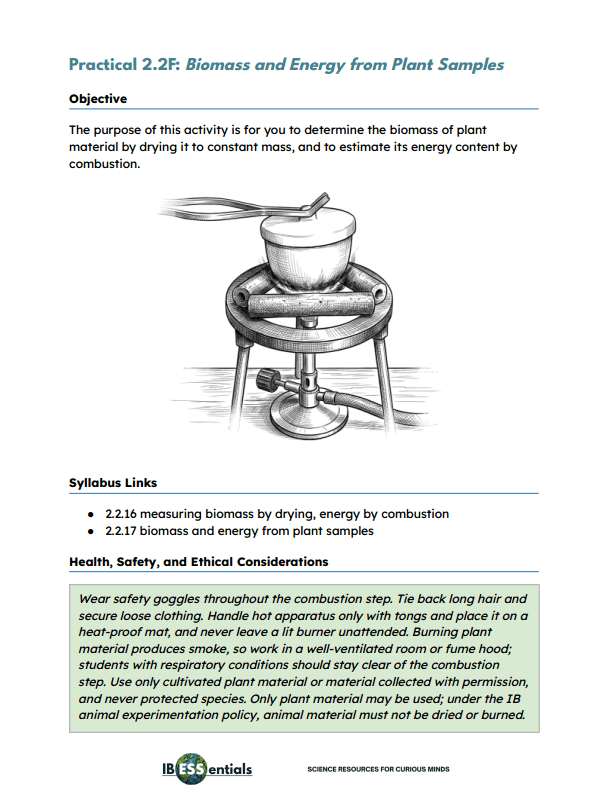
Give students hands-on laboratory experience of the standard methods for measuring biomass and the energy it stores.
In this two-part practical activity, students work with samples of fresh plant material:
- Part 1 — Biomass: students weigh fresh plant material, dry it at 80 °C, cool it in a desiccator, and reweigh it repeatedly until two successive masses agree within 0.02 g (constant mass). They then calculate the dry mass and the percentage water content of the fresh sample.
- Part 2 — Energy content: students burn a weighed portion of dried plant material beneath a boiling tube of water and record the temperature rise. They use E = m × c × ΔT to calculate the energy released and express it as energy per gram of dry biomass, repeating the combustion at least three times.
Students then compare their energy value with a published figure for plant material. Classroom calorimetry results usually fall well short of published values, and working out why gives students a genuine error-analysis problem.
This is the main wet-lab quantitative procedure in Topic 2 and connects directly to the biomass and energy data used in ecological pyramids.
IB ESS Internal Assessment Skills
This activity is assessed using IB ESS Internal Assessment Criteria C: Method and F: Evaluation, and the full rubrics are included. Students must:
- Describe both procedures clearly enough to be repeated with comparable results, including how constant mass was established and how the combustion step was standardized
- Compare their result with a published value, evaluate the specific limitations that explain the difference, and suggest an improvement addressing the largest source of error
- Describe an unresolved question arising from their results and explain how it affects conclusions about energy stored at the producer level
The activity is excellent preparation for Criterion F. Heat lost to the air, incomplete combustion, and heat absorbed by the glassware are specific, nameable limitations, so students learn to evaluate beyond generic comments about “human error.” The teacher’s notes also explain why this activity has the most significant safety requirements in Topic 2, and why only plant material may be used under the IB animal experimentation policy.
Ideal for
- Measuring biomass by drying to constant mass
- Estimating energy content by combustion
- Introducing simple calorimetry
- Calculating percentage water content
- Teaching experimental error and evaluation
- Linking lab data to ecological pyramids
- Preparing students for the IB ESS Internal Assessment
Digital download. No physical product will be shipped.


You must be logged in to post a comment.