


Description
IB ESS Practical 2.2E: Ecological Pyramids 
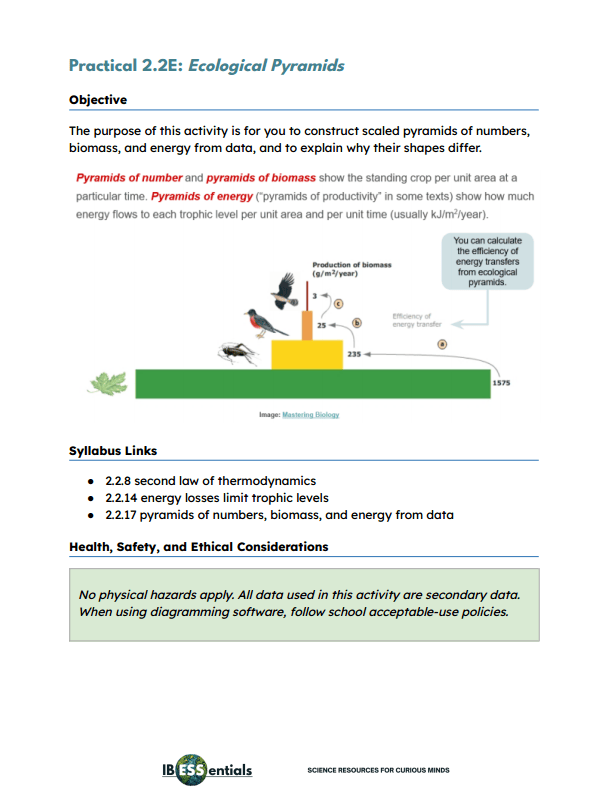
Teach students to construct and interpret pyramids of numbers, biomass, and energy from real species data.
In this practical activity, students work from three North American data sets, each recorded in a different unit:
- Temperate deciduous forest: species including gray wolves, red foxes, snowshoe hares, and three producer species, measured in kg km⁻²
- Desert ecosystem: Indian rice grass, cottontail rabbits, bobcats, and black vultures, measured in kcal m⁻²
- Grassland ecosystem: big bluestem grass, rove beetles, red-winged blackbirds, and western fox snakes, counted as individuals
Before drawing anything, students use the units as evidence to decide which type of pyramid each data set supports. They then:
- Assign trophic levels to every organism, combining values where several organisms share a level
- Draw each pyramid to scale and record the scale used
- Calculate transfer efficiency between consecutive trophic levels for the biomass and energy pyramids
- Explain unusual shapes by identifying any inverted or irregular pyramid and the ecological circumstances that could produce it
Write-in space is provided for each pyramid type.
The grassland data set, with over 58 million grass plants and just three snakes, is nearly impossible to draw to true scale. That frustration is productive, because it shows students why pyramids of numbers are often drawn without scale and why this limits their usefulness.
IB ESS Internal Assessment Skills
This activity is assessed using IB ESS Internal Assessment Criteria D: Treatment of Data and E: Analysis and Conclusion, and the full rubrics are included. Students must:
- Present three scaled pyramids with all labels, units, and scales, along with their efficiency calculations
- Analyze the differences in shape between the pyramids, separating features caused by the type of measurement from genuine ecological features, and including the uncertainty of combining organisms at the same trophic level
- Explain why a pyramid of energy can never be inverted, with reference to the second law of thermodynamics
The activity teaches students to choose an appropriate way to present data before presenting it, which is a key part of data communication in the IA. The teacher’s notes emphasize that deciding which pyramid each data set supports is the core skill being assessed.
Ideal for
- Teaching ecological pyramids
- Comparing pyramids of numbers, biomass, and energy
- Explaining inverted pyramids
- Calculating transfer efficiency
- Teaching the second law of thermodynamics
- Practicing scaled data presentation
- Preparing students for the IB ESS Internal Assessment
Digital download. No physical product will be shipped.


You must be logged in to post a comment.