


Description
 IB ESS Practical 2.2C: Food Webs from Data
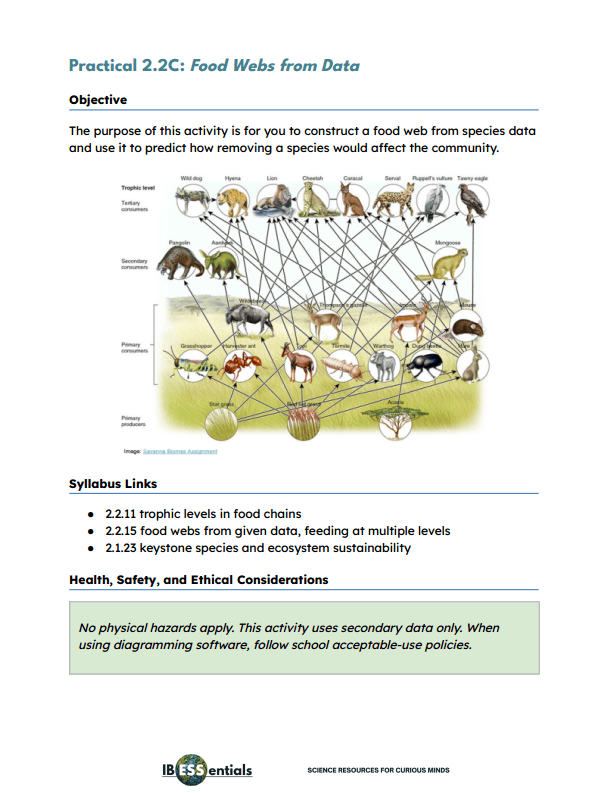
Take students beyond simple food chains by having them build a food web and use it to predict what happens when a species disappears.
In this practical activity, students use the coastal grassland data from Practical 2.2B, or an extended data set provided by the teacher, to construct a food web. They:
- Build the web: arrange producers along the bottom and consumers above them by trophic level, drawing arrows in the direction of energy flow
- Highlight complexity: mark every species that feeds at more than one trophic level in a different color and explain why each qualifies
- Trace energy pathways: count the separate routes energy can take from one named producer to the top consumer
- Predict removals: remove one species and trace every direct and indirect effect, then repeat for a second species in a different position in the web
- Identify a keystone species: compare the two removals to decide which species has the stronger claim to be a keystone species
- Model seasonal change: redraw the web to show a seasonal change, such as a migratory species leaving or a plant becoming dormant
Comparing two removals teaches students to reason about keystone species from evidence rather than simply naming the top predator. It also prepares them for trophic cascades and rewilding in Topic 3.
IB ESS Internal Assessment Skills
This activity is assessed using IB ESS Internal Assessment Criteria C: Method and E: Analysis and Conclusion, and the full rubrics are included. Students must:
- Describe how they constructed and modified their food web clearly enough for another student to produce an equivalent web
- Analyze the predicted consequences of both removals, explain which indirect effects are most and least certain, and identify the limits of predicting from a web with no quantities
- Draw a conclusion about which species acts as a keystone species, supported by their comparison of the two removals
The activity shows students the difference between a model and a prediction. Direct effects are easy to trace, but indirect effects are genuinely uncertain. The teacher’s notes explain how recognizing that uncertainty is exactly the kind of reliability discussion the upper IA mark bands require.
Ideal for
- Teaching food webs
- Teaching organisms that feed at multiple trophic levels
- Teaching keystone species
- Predicting the effects of species loss
- Introducing trophic cascades
- Modeling seasonal changes in ecosystems
- Preparing students for the IB ESS Internal Assessment
Digital download. No physical product will be shipped.


You must be logged in to post a comment.