


Description
IB ESS Practical 2.1C: Niches and Carrying Capacity 
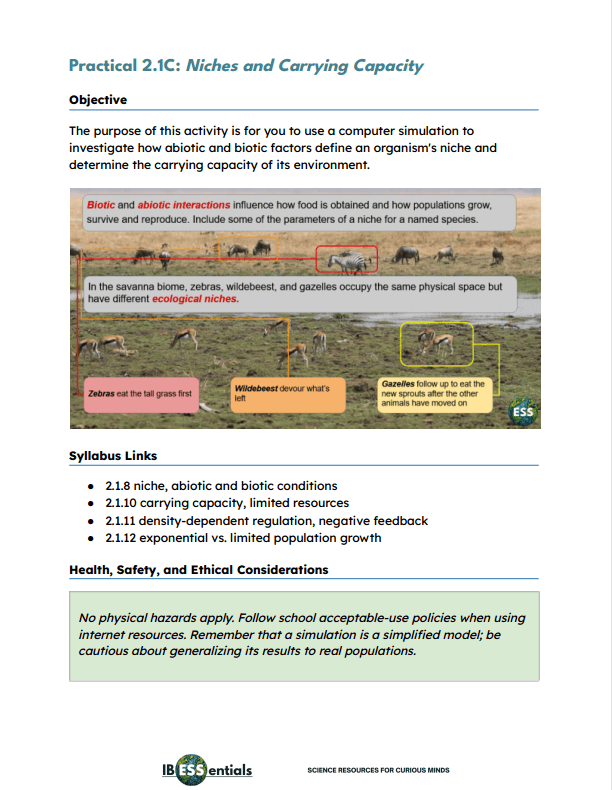
Make carrying capacity and population growth visible to students with this simulation-based practical activity.
In this activity, students use the PhET Natural Selection simulation, or an equivalent population simulation, to test how limiting factors shape a population. They let a population establish itself and then run three configurations:
- Abiotic factor: change one abiotic condition, such as switching from equatorial to arctic conditions
- Biotic factor: change one biotic factor instead, such as introducing a predator or limiting the food supply
- Combined: combine one abiotic and one biotic factor, adjusting the settings until the population settles at a level it returns to after disturbance
Each configuration is run at least three times because simulation outcomes vary. Students plot population size against generation for every configuration, label each curve as exponential or limited growth, and mark the carrying capacity wherever one is reached.
By producing both J-shaped and S-shaped curves from the same simulation, students see how density-dependent factors regulate populations through negative feedback.
IB ESS Internal Assessment Skills
This activity is assessed using IB ESS Internal Assessment Criteria D: Treatment of Data and E: Analysis and Conclusion, and the full rubrics are included. Students must:
- Present population data for every configuration and state the rule they used to identify carrying capacity
- Analyze the differences between unlimited and limited growth curves, including the uncertainty caused by variation between repeat runs
- Explain how their limiting factor regulated population size and draw a conclusion about resource availability and carrying capacity
The activity gives students practice with a genuine processing judgment: identifying carrying capacity from variable data. It also shows them why repeat trials are needed even in a computer model. The teacher’s notes emphasize naming the regulating mechanism rather than simply describing the curve.
Ideal for
- Teaching carrying capacity
- Comparing exponential and limited population growth
- Teaching J-curves and S-curves
- Explaining limiting factors and niches
- Teaching density-dependent regulation and negative feedback
- Using simulations in ecology lessons
- Preparing students for the IB ESS Internal Assessment
Digital download. No physical product will be shipped.


You must be logged in to post a comment.